AI Architecture Ecosystem Contribution Map
The handbook is the discovery layer for a wider set of open-source AI engineering projects. Use this map to choose the repository where your contribution will have the clearest technical impact.
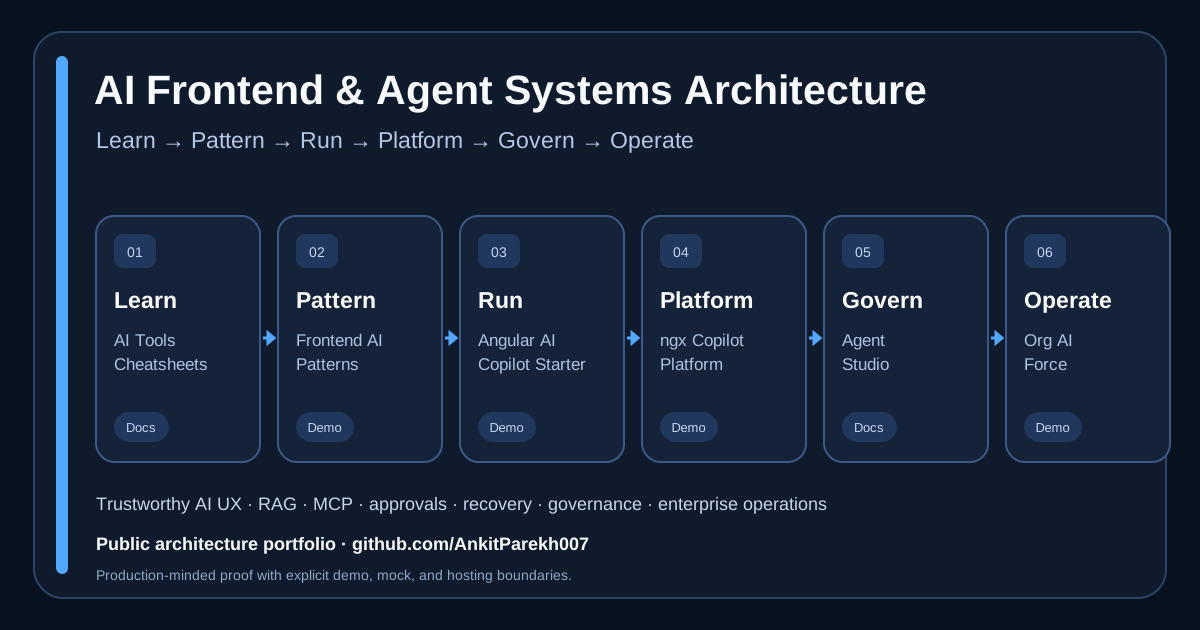
The ecosystem follows one progression: Learn → Pattern → Run → Platform → Govern → Operate.
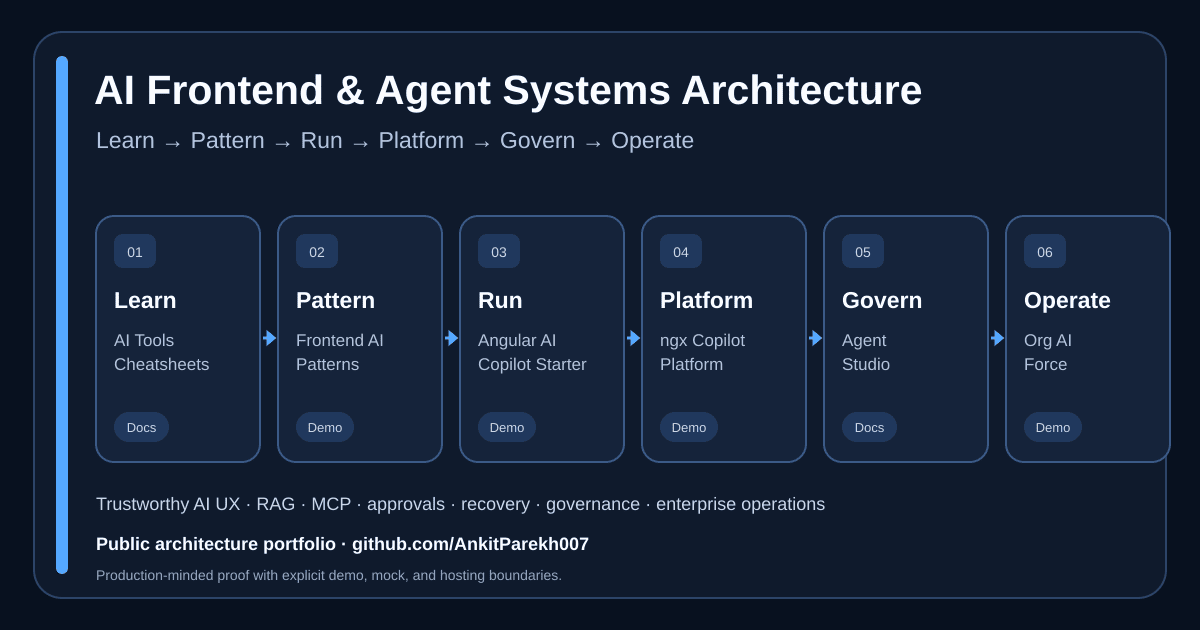
Use the Architecture Path to understand why each layer exists, then choose the matching repository below. The visual is also available as an editable SVG.
Choose by the problem you want to solve
| You want to improve… | Best repository | Typical contribution |
|---|---|---|
| AI coding workflows, prompts, MCP guidance, tool comparisons | ai-tools-cheatsheets |
source-backed docs, verification, examples, workflow improvements |
| trustworthy AI frontend state and reusable contracts | frontend-ai-patterns |
pattern contracts, fixtures, accessibility, recovery states, starter packs |
| polished Angular copilot UX | angular-ai-copilot-starter |
Angular UI, accessibility, responsive behavior, deterministic scenarios, screenshots |
| full-stack Angular AI SDK/backend integration | ngx-copilot-platform |
SDK contracts, streaming, RAG, approvals, adapter failures, backend tests |
| governed agent lifecycle and publication | agent-studio |
lifecycle policy, RBAC, provisioning, runtime adapters, deployment, security tests |
| enterprise agent workspace and operations | org-ai-force |
orchestration, readiness, RAG/tools, browser workers, operations UX, resilience |
Contribution paths
Documentation-first contributor
Start here:
- improve a source-backed page in
ai-tools-cheatsheets; - add or clarify one architecture pattern in
frontend-ai-patterns; - document the implementation bridge to the runnable Angular starter.
This path is ideal when you want a focused first PR without setting up a full application stack.
Frontend contributor
Start with:
frontend-ai-patternsfor contracts and state models;angular-ai-copilot-starterfor visual Angular implementation;ngx-copilot-platformwhen you want the frontend/backend contract boundary.
High-value areas include:
- keyboard and screen-reader behavior
- streaming state transitions
- citation/source UX
- tool timeline clarity
- approval/rejection states
- retry/recovery UX
- responsive layouts
- deterministic fixture/test coverage
Backend / platform contributor
Start with ngx-copilot-platform or agent-studio.
Useful contribution themes:
- typed API contracts
- semantic failure responses
- auth/RBAC boundaries
- idempotency
- retry policy
- auditability
- provider/runtime adapters
- secrets and configuration validation
- deployment verification
Agent / operations contributor
Start with agent-studio for governed lifecycle work or org-ai-force for enterprise workspace/orchestration work.
Useful themes:
- immutable version policy
- approval/separation of duties
- provisioning callbacks
- publication/revocation
- agent orchestration
- readiness and health surfaces
- browser worker failure modes
- degraded dependency handling
What makes a strong contribution
Across the ecosystem, prefer contributions that are:
- small enough to review — one focused problem per PR;
- explicit about boundaries — mock/demo behavior should stay labeled;
- testable — add deterministic tests when behavior changes;
- accessible — UI work should include keyboard and assistive-technology considerations;
- security-aware — frontend visibility never substitutes for backend authorization;
- evidence-backed — docs should cite primary/official sources where external facts matter;
- honest about failure — unsuccessful operations must not become success states.
Suggested first contributions
If you are unsure where to start, choose one of these shapes:
- improve one command/source/verification note in the handbook;
- add one deterministic failure scenario to an AI frontend example;
- improve one RAG citation or tool-timeline accessibility behavior;
- add one lifecycle edge-case test to Agent Studio;
- add one enterprise degraded-dependency test to Org AI Force;
- capture or refresh a recruiter-quality screenshot/GIF using the repository's public-proof guide.
Review before opening a PR
In the target repository:
- read
CONTRIBUTING.md; - check existing issues for
good first issueorhelp wanted; - run the repository's documented validation commands;
- keep generated secrets, API keys, and local environment files out of the commit;
- explain what changed, why, testing, screenshots when visual, and any security/trust impact.
Architecture learning path
If you want to understand the system before contributing, follow the handbook's Architecture Path:
- trustworthy AI frontend state;
- runnable Angular copilot UX;
- full-stack copilot platform;
- governed agent lifecycle;
- enterprise agent workspace.
That path explains the new engineering problem introduced at each layer before linking you into the implementation repository.