From AI Coding Tools to AI Application Architecture
This handbook helps you use AI engineering tools well. The next architecture problem begins when AI stops being a developer assistant and becomes part of the product itself.
Use this path to move from tool adoption to trustworthy frontend state, runnable AI UX, full-stack copilot boundaries, governed agent lifecycle, and finally enterprise agent operations.
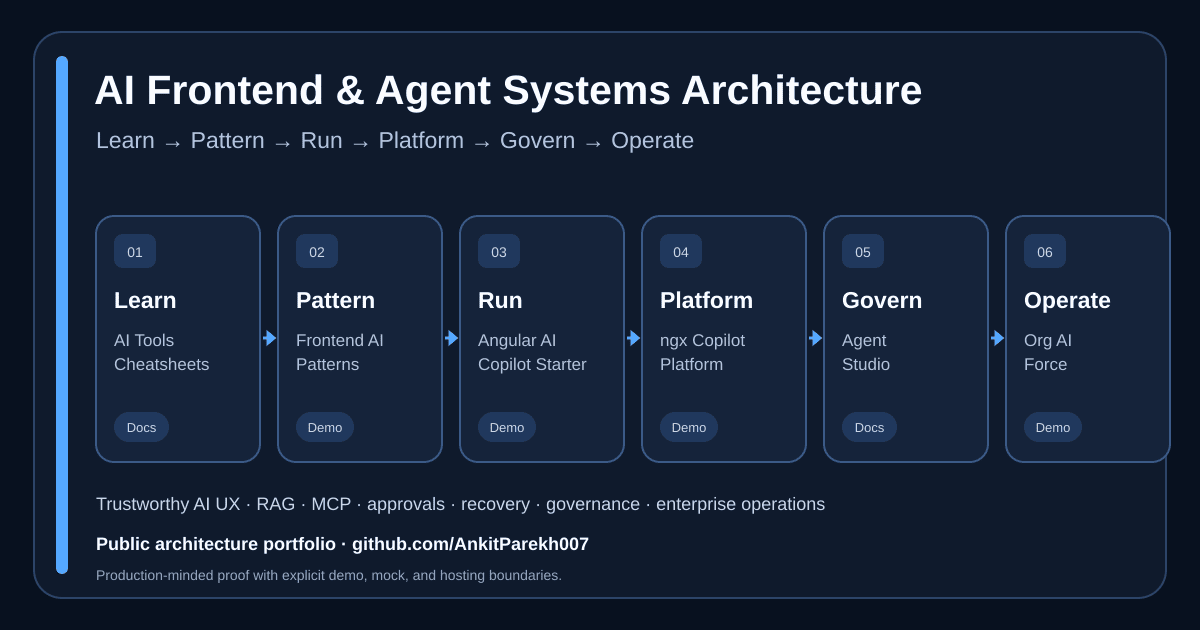
The shareable card above is also available as an editable SVG source. It maps the public portfolio without claiming that prototype or production-shaped repositories are deployed production systems. If you want to contribute at one of these layers, use the Ecosystem Contribution Map.
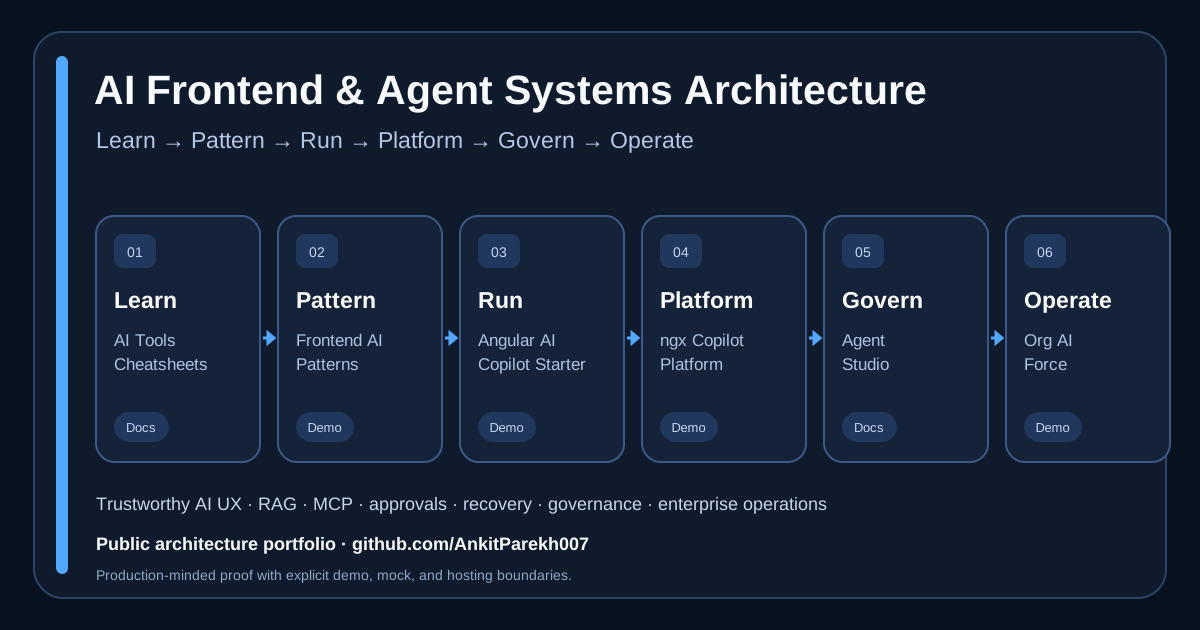
AI coding tools and workflows
        ↓
Trustworthy AI frontend state
        ↓
Runnable Angular copilot UX
        ↓
Full-stack copilot platform
        ↓
Governed agent lifecycle
        ↓
Enterprise agent workspace
| Stage | New architecture problem | Continue with |
|---|---|---|
| Tool adoption | How do engineers use agents safely and repeatably? | This handbook |
| Frontend state | How does the UI represent streaming, evidence, tools, approvals, and recovery? | Trustworthy AI frontend state |
| Runnable UX | How do those patterns behave together in a working application? | Runnable Angular copilot |
| Full-stack boundary | Which responsibilities belong in the browser vs backend? | Full-stack copilot platform |
| Agent governance | How are versions, approvals, publications, runtimes, and revocation controlled? | Governed agent lifecycle |
| Enterprise operations | How do RBAC, RAG, tools, workers, readiness, and observability work together? | Enterprise agent workspace |
What changes at each layer
Tools → product state
AGENTS.md, prompts, MCP, coding agents, and workflows improve engineering work. Product AI adds persistent user-visible state: partial streams, citations, proposed actions, approval boundaries, failures, retries, and auditability.
Product state → executable UX
Individual patterns are easier to reason about than complete flows. A runnable reference shows whether state transitions remain understandable when retrieval fails, approval is rejected, or a tool errors.
Executable UX → backend boundary
Once tools or sensitive data are involved, browser-only trust is insufficient. Credentials, retrieval authorization, tool policy, approval enforcement, idempotency, and audit logging move behind a server boundary.
Backend boundary → governed agents
Long-lived agents introduce immutable versions, review/approval, publication channels, runtime adapters, revocation, provisioning retries, and separation of duties.
Governed agents → enterprise operations
Organization-wide use adds role-aware workspaces, connector governance, browser workers, readiness, observability, pilot rollout, and degraded-dependency behavior.
Why these pages link out
The handbook intentionally does not duplicate application source code. Each bridge page explains the architecture problem and then links to a focused public implementation repository where that layer can be inspected and run.