Who it is for
- AI/frontend candidates with weak public proof
- Angular and TypeScript engineers repositioning toward AI product work
- People who need stronger GitHub, portfolio, and interview evidence
Occupation-Ops turns vague experience into recruiter-readable public proof. It is not a mass-apply tool, not a scanner, and not a tracker.
Built for candidates who need stronger proof before more outreach.
The website explains the system. The terminal does the work. The flagship command generates a full proof dossier with Markdown, JSON, and HTML outputs.
Occupation-Ops is most valuable when the candidate problem is weak public proof, not weak application volume.
The docs are structured around how developers use and extend the repo: onboarding, CLI usage, rubrics, output bundles, and architecture.
Clone, install, run one command, and open the flagship proof dossier in your browser.
Open docs ->The product surface is the terminal. Every core command has a concrete output bundle.
Open docs ->Architecture, rubric structure, validators, and extension points for contributors.
Open docs ->See the flagship output bundle before cloning the repo.
Open docs ->This is not a chat prompt wrapper. The output is a rubric-scored dossier with explicit proof signals.
Fill in profile.yml with your current positioning, links, skills, and proof artifacts.
Occupation-Ops scores the profile against a rubric, not just generic prose templates.
Open the HTML output to see score, gaps, validators, and backlog in one place.
Use the GitHub rewrite, project briefs, and weekly plan to improve what recruiters actually see.
The launch surface now includes actual dossier visuals so cold visitors can judge the output quality quickly.
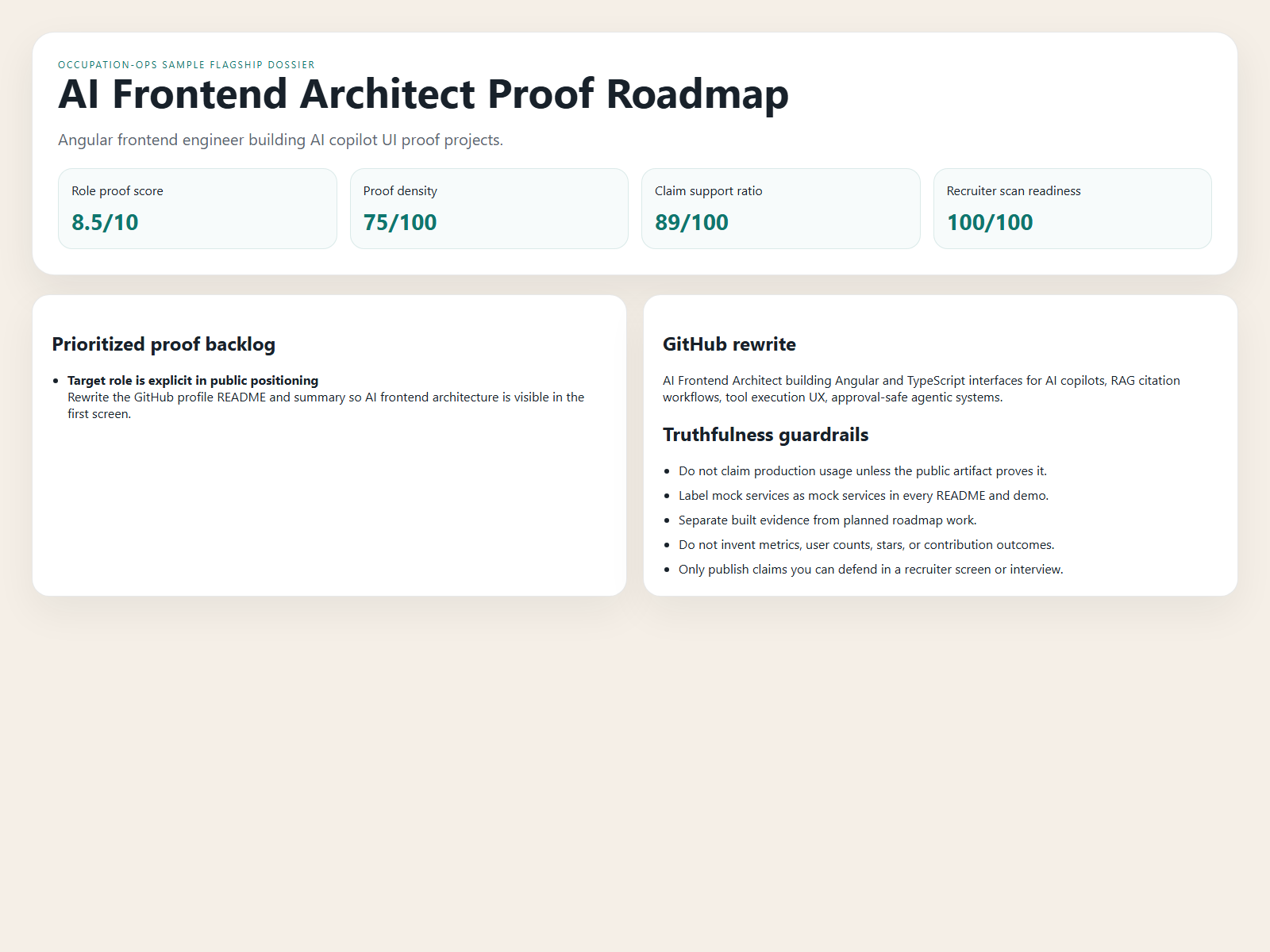
One HTML report that shows score, proof backlog, GitHub rewrite, validators, and weekly plan.
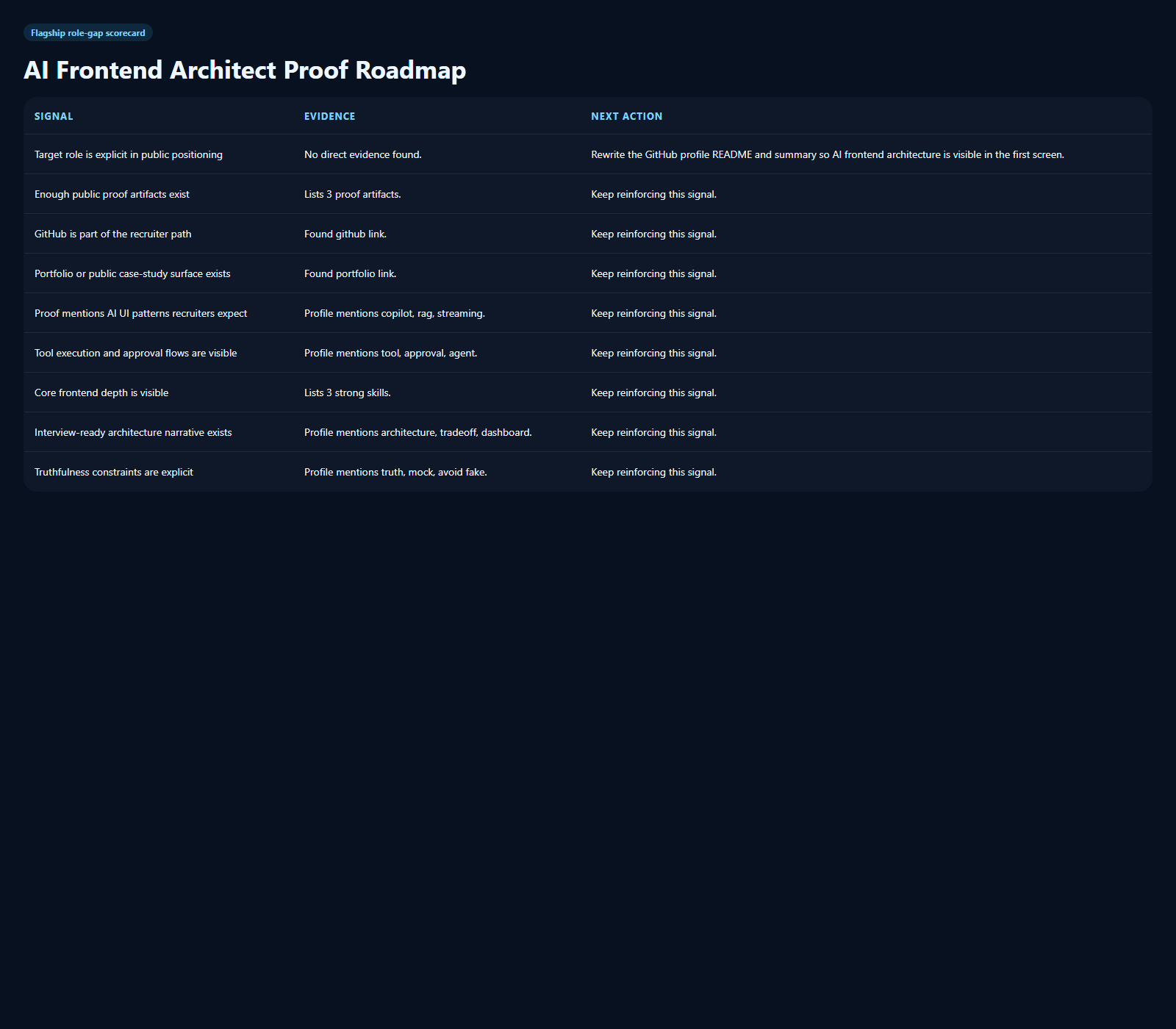
The core evaluation is explicit about what is supported, what is missing, and what to improve next.
The competitive advantage is narrower and stronger: help AI/frontend candidates build proof before they apply, so their GitHub, portfolio, and interview narratives hold up.
The AI Frontend Architect dossier is the wedge. The homepage, docs, sample outputs, and launch assets should all make that visible within one screen.